
Shipping Container Dimensions: Inside Sizes, Door Openings and the Numbers That Actually Limit Your Load
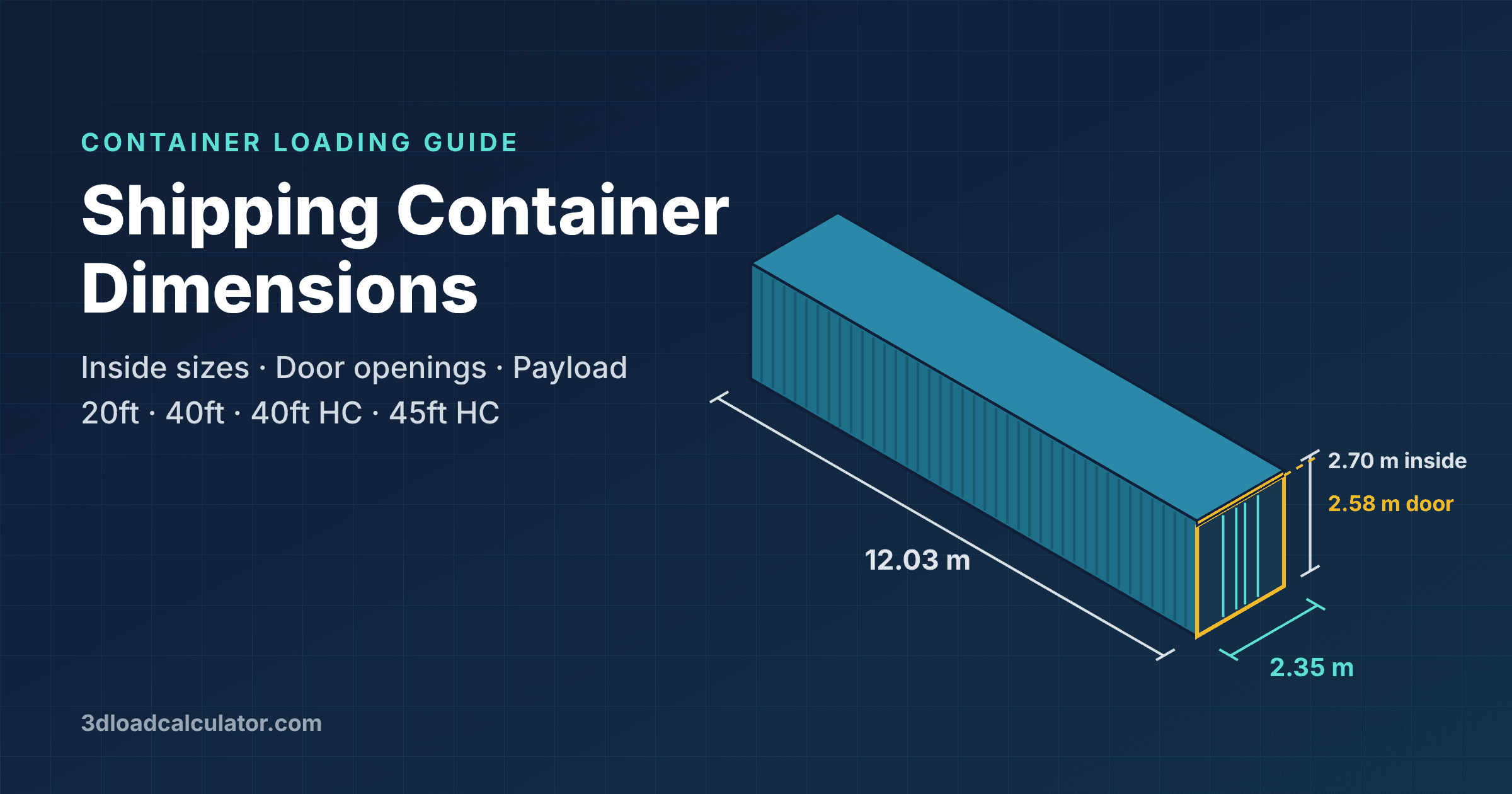
Everyone knows a 40-foot container is about 12 metres long. Fewer people know which of its numbers will stop a shipment first.
A container spec sheet lists six or seven figures: length, width, height, door width, door height, tare and payload. They are all correct. But on any given load, only one of them is the real limit — and it is often not the one the booking was based on.
This guide covers the inside dimensions of the common dry, high-cube, open-top and reefer containers. It also shows how to work out, before booking, which number will actually limit your cargo.
The reference table
These are representative figures for standard ISO containers, based on published carrier and forwarder specifications (DSV dry, high cube, open top and reefer). Real units vary by manufacturer, age and owner. For a specific box, check the container operator's equipment specifications for exact dimensions, and the CSC plate on the door for that unit's certified weight ratings.
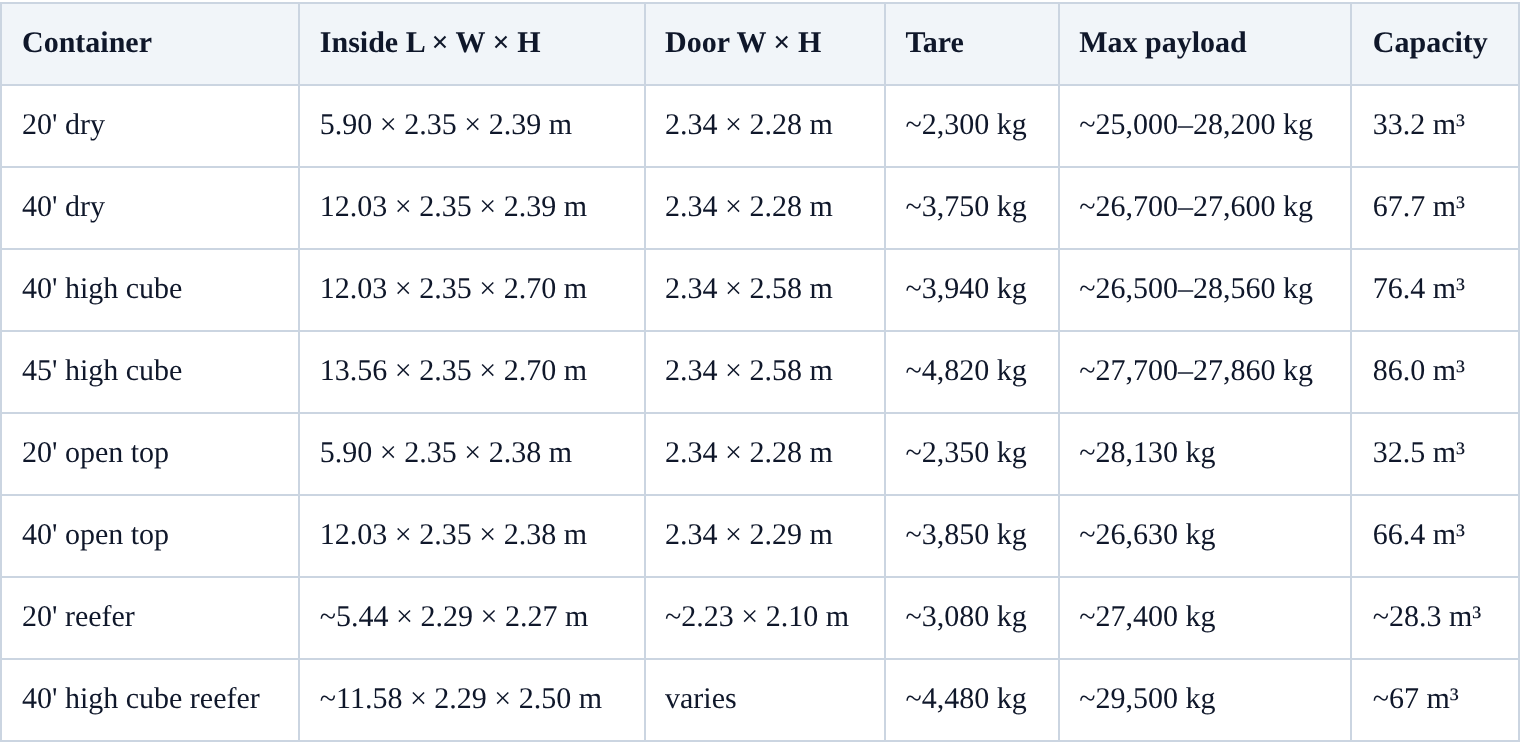
20' dry — Inside L × W × H: 5.90 × 2.35 × 2.39 m · Door W × H: 2.34 × 2.28 m · Tare: ~2,300 kg · Max payload: ~25,000–28,200 kg · Capacity: 33.2 m³
40' dry — Inside L × W × H: 12.03 × 2.35 × 2.39 m · Door W × H: 2.34 × 2.28 m · Tare: ~3,750 kg · Max payload: ~26,700–27,600 kg · Capacity: 67.7 m³
40' high cube — Inside L × W × H: 12.03 × 2.35 × 2.70 m · Door W × H: 2.34 × 2.58 m · Tare: ~3,940 kg · Max payload: ~26,500–28,560 kg · Capacity: 76.4 m³
45' high cube — Inside L × W × H: 13.56 × 2.35 × 2.70 m · Door W × H: 2.34 × 2.58 m · Tare: ~4,820 kg · Max payload: ~27,700–27,860 kg · Capacity: 86.0 m³
20' open top — Inside L × W × H: 5.90 × 2.35 × 2.38 m · Door W × H: 2.34 × 2.28 m · Tare: ~2,350 kg · Max payload: ~28,130 kg · Capacity: 32.5 m³
40' open top — Inside L × W × H: 12.03 × 2.35 × 2.38 m · Door W × H: 2.34 × 2.29 m · Tare: ~3,850 kg · Max payload: ~26,630 kg · Capacity: 66.4 m³
20' reefer — Inside L × W × H: ~5.44 × 2.29 × 2.27 m · Door W × H: ~2.23 × 2.10 m · Tare: ~3,080 kg · Max payload: ~27,400 kg · Capacity: ~28.3 m³
40' high cube reefer — Inside L × W × H: ~11.58 × 2.29 × 2.50 m · Door W × H: varies · Tare: ~4,480 kg · Max payload: ~29,500 kg · Capacity: ~67 m³
The same table in feet and inches
Imperial dimensions are rounded down to the nearest inch, so a load planned to these numbers will not come out a fraction too big.
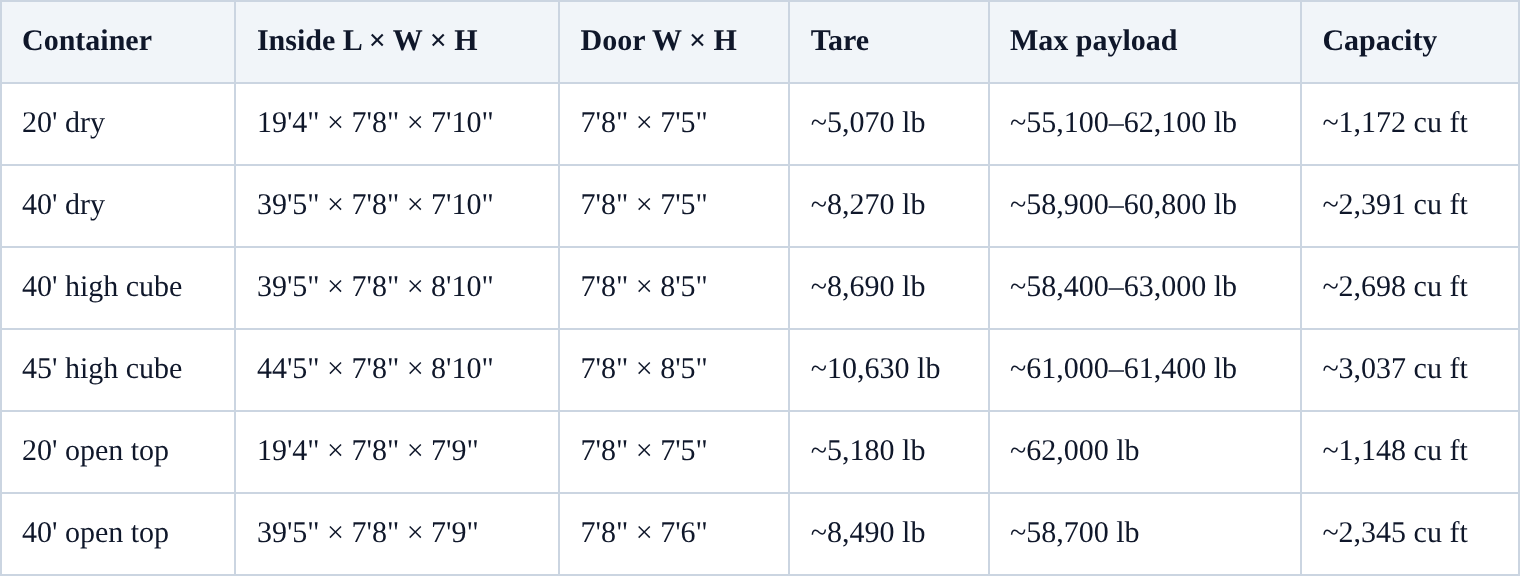
20' dry — Inside L × W × H: 19'4" × 7'8" × 7'10" · Door W × H: 7'8" × 7'5" · Tare: ~5,070 lb · Max payload: ~55,100–62,100 lb · Capacity: ~1,172 cu ft
40' dry — Inside L × W × H: 39'5" × 7'8" × 7'10" · Door W × H: 7'8" × 7'5" · Tare: ~8,270 lb · Max payload: ~58,900–60,800 lb · Capacity: ~2,391 cu ft
40' high cube — Inside L × W × H: 39'5" × 7'8" × 8'10" · Door W × H: 7'8" × 8'5" · Tare: ~8,690 lb · Max payload: ~58,400–63,000 lb · Capacity: ~2,698 cu ft
45' high cube — Inside L × W × H: 44'5" × 7'8" × 8'10" · Door W × H: 7'8" × 8'5" · Tare: ~10,630 lb · Max payload: ~61,000–61,400 lb · Capacity: ~3,037 cu ft
20' open top — Inside L × W × H: 19'4" × 7'8" × 7'9" · Door W × H: 7'8" × 7'5" · Tare: ~5,180 lb · Max payload: ~62,000 lb · Capacity: ~1,148 cu ft
40' open top — Inside L × W × H: 39'5" × 7'8" × 7'9" · Door W × H: 7'8" × 7'6" · Tare: ~8,490 lb · Max payload: ~58,700 lb · Capacity: ~2,345 cu ft
Two details in that table matter more than they look.
The width is the same on every dry container. 2.35 metres, whether you book a 20', a 40' or a 45'. Going bigger buys length (and, with a high cube, height). It never buys width. If your cargo problem is width, a bigger container will not solve it.
The door is lower than the inside. On a 40' high cube, the inside height is 2.70 m but the door opening is about 2.58 m. A crate 2.65 m tall fits inside the container. It does not fit through the door.
Five numbers, five different limits
When a load does not fit, it is almost always one of these five reasons. They are worth checking in this order.
1. Door opening. For door loading, this is the first gate. A single item that will not go through the door in any allowed orientation ends the conversation, whatever the volume and weight say. It catches tall machinery, long crates that need to be tilted and anything marked "this side up" that is taller than 2.28 m in a standard box. The reverse is not automatic, though: an item that clears the door still needs room inside to be manoeuvred into its final position.
2. Inside width. 2.35 m sounds generous until you put two 1.2 m items side by side: 2.40 m. Two Euro pallets loaded long side across do not fit. The same is true of any cargo that is a little over half the container width — it loads one across, and the rest of that row is empty air.
3. Inside height. This is where high cubes earn their money, but only if the cargo stacks. An extra 31 cm of height is useless if every item is marked Do Not Stack. It is also useless if the stack is already at its weight limit.
4. Payload. The weight limit is per container, not per cubic metre. Dense cargo — tiles, paper, metal parts, liquids in drums — runs out of payload long before it runs out of space.
5. Road weight. The container's rated payload is not always the weight you are allowed to drive. Road limits apply to the whole truck — tractor, chassis and container together — so in many markets the legal cargo weight on the road is below the container's own maximum. Check the inland leg, not just the ocean leg.
The density test: which number will limit you?
There is a quick way to tell, before planning anything, whether a shipment will run out of space or out of weight first.
Start from realistic usable volume, not the capacity on the spec sheet. Cargo never fills 100% of a container. Gaps around odd-sized items, door clearance and stacking limits mean around 85% is a good planned result for standard dry cargo. (We covered why in Container Utilization: The Cost Hiding in Plain Sight.)
Divide the payload by that usable volume and you get a break-even cargo density:
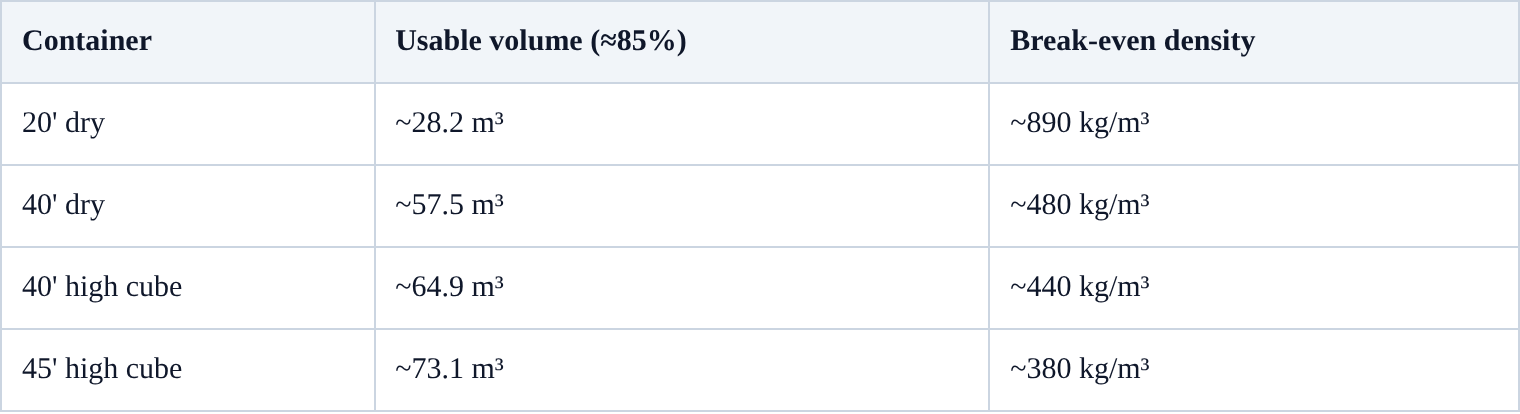
20' dry — Usable volume (≈85%): ~28.2 m³ · Break-even density: ~890 kg/m³
40' dry — Usable volume (≈85%): ~57.5 m³ · Break-even density: ~480 kg/m³
40' high cube — Usable volume (≈85%): ~64.9 m³ · Break-even density: ~440 kg/m³
45' high cube — Usable volume (≈85%): ~73.1 m³ · Break-even density: ~380 kg/m³
(Calculated with the representative payloads above: 25,000 kg, 27,600 kg, 28,560 kg and 27,860 kg.)
To use it, take your shipment's total weight and divide by its total volume.
If your cargo density is above the break-even point, weight is likely to become the limiting factor before volume.
Below that point, space is more likely to be the constraint, and bigger or taller containers tend to help.
Treat this as a first screen, not a verdict. Actual loading geometry, stacking restrictions and weight distribution can change the result — a low-density load can still fail to fit if its items do not stack or nest well.
Here is the counterintuitive part. A 40' high cube has about 13% more space than a 40' dry container. But at anything above roughly 440 kg/m³, that extra space is unlikely to be usable — the container will usually hit its payload first. Many teams book high cubes by default "for the extra space" and then ship that extra space empty.
The 20' is the opposite. It has the highest break-even density because its payload is almost as large as a 40's in half the length. That is why heavy cargo moves in 20s.
A mixed shipment rarely has one density. Light cartons and heavy machine parts in the same load give an average that hides the real problem. It is better to plan the actual items. That is the only way to see whether the heavy pieces can sit low and central and the light ones can fill the space above.
Not sure whether your cargo is limited by weight or by space? Test your actual packing list in 3DLoadCalculator.
Three cases where the "obvious" container was wrong
These illustrative scenarios show how a container can appear suitable on paper but fail a more detailed loading check.
The machine that fitted on paper. A 2.62 m tall press was booked into a 40' high cube. Inside height: 2.70 m. Door height: 2.58 m. It came back to the yard, and the shipment moved on an open top a week later. If the press had also stood above the top of the open-top container, it would have become out-of-gauge cargo, with special permits and extra costs. The door check is the cheapest one to do and the most expensive one to skip.
The high cube that shipped air. 22 tonnes of ceramic tiles, about 30 m³ of cargo. That is around 730 kg/m³ — well above the 40' high cube break-even of ~440 kg/m³, so weight was always likely to be the limit. A 20' dry container could potentially have carried the same cargo by weight, although fitting 30 m³ into its 33.2 m³ capacity — about 90%, above the 85% planning assumption — would require a carefully verified loading plan, and might not work at all depending on the packaging and pallet sizes. Instead it shipped in a 40' HC that was 39% full by volume, with the rest paid for and shipped empty.
The width trap. Crates 1.25 m wide, to be loaded two across. 2 × 1.25 = 2.50 m, against a 2.35 m interior. In a 45' that became one crate across, plus a 1.10 m gap the full length of the box. Turning the crates 90° fixed it — but only after the booking.
None of these needed a better container. They needed someone to check the right number before booking. (For the full booking decision, see The Container Size Decision Most Teams Make in Thirty Seconds.)
Open tops and reefers: same outside, different inside
Open top containers have roughly the same footprint as dry boxes. The difference is that the roof can be removed, and on many units the door header can be swung out or removed too — depending on the container design. Cargo can then go in from above with a crane. Use them when the door is the limit, not the volume. Cargo that stands above the top of the container becomes out-of-gauge, which brings special permits, stowage restrictions and extra costs. Open-top payloads are similar to dry units, but the inside height under the roof bows is slightly lower.
Reefers are the opposite surprise. The insulation and the refrigeration unit take space, so a 40' high cube reefer has about the same inside volume as a standard 40' dry, not a 40' high cube. Reefers also have a red load line near the top that cargo must stay below for the air to circulate. The usable height is therefore lower than the inside height on the spec sheet.
Running the check before the booking
The first four checks above take a few minutes per shipment with a spreadsheet. They take seconds in a load planner, which does them every time without anyone needing to remember. The fifth — road weight — and the handling questions around it still need a person who knows the route.
What 3DLoadCalculator checks for you:
Door check flags any item that cannot pass through the container door in an allowed orientation.
Inside width and height are respected in every plan, along with Do Not Stack, Do Not Rotate and the other constraints you set per item.
Payload and volume bars show weight and space use per container, so you can see at a glance which one will run out first.
Center of gravity analysis rates each container from Optimal to Critical, so an unbalanced load is visible before it reaches the dock. (More on this in our next post.)
Custom equipment lets you enter the exact unit you are getting — length, width, height, door width and height, payload, tare and maximum gross weight — instead of a generic one.
What you still need to verify yourself:
Road and rail limits. You can lower a container's maximum gross weight in custom equipment to reflect a known inland limit, but that does not replace a check of the vehicle, chassis, axle loads and the road rules of each country on the route.
Lifting, securing and handling. A good center of gravity rating does not on its own guarantee that a load can be lifted or carried safely. Securing, lashing and handling equipment still need to be planned.
Manoeuvring room for large items that must be tilted, turned or slid into position by forklift or crane.
You can compare a 20', a 40' and a 40' high cube with the same cargo list in one project. Choose the container that limits you least, not the one that sounds biggest.
Frequently asked questions
What are the inside dimensions of a 40ft container? A standard 40' dry container is about 12.03 m long, 2.35 m wide and 2.39 m high inside (about 39'5" × 7'8" × 7'10"), with a door opening of about 2.34 × 2.28 m. A 40' high cube has the same length and width but is about 2.70 m (8'10") high inside, with a door opening of about 2.58 m (8'5") high.
How much more space does a high cube have? About 31 cm more height and around 13% more volume than a standard container of the same length (76.4 m³ vs 67.7 m³ for a 40'). It only helps if your cargo can use the height — that is, if it stacks and you are not already at the weight limit.
Is the door opening the same as the inside size? No. The door is slightly narrower than the interior and noticeably lower — about 11 cm lower on a standard container and about 12 cm lower on a high cube. Always check tall items against the door height.
How do I know if my shipment is limited by weight or by volume? Divide the total weight by the total volume as a first screen. If the result is above about 440 kg/m³ for a 40' high cube (or about 890 kg/m³ for a 20'), weight is likely to run out first. Stacking restrictions, item shapes and weight distribution can still change the answer, so confirm it with a load plan.
Are these dimensions exact? No. They are representative values. Dimensions, tare and payload vary by manufacturer, age and owner. Check the container operator's equipment specifications for exact dimensions, and the CSC plate on the door for that unit's certified weight ratings.
Plan your next shipment against the real limits. Import your packing list, compare container sizes side by side and see the door, payload and balance checks before you book.